
“Should we restructure our accounting or hire a U.S. CFO when raising capital from U.S. investors?” – Israeli and other international founders often ask this. ERB Proximo hears this question frequently. In reality, you do not have to incorporate a U.S. company or set up a local office just to raise money, but you do need clear financial controls, accurate reporting, and compliance with U.S. rules. U.S. venture capitalists will scrutinize your books, forecasts and ownership during due diligence. This article explains why your accounting structure matters for U.S. fundraising and what steps to take.
Key Highlights
- Exemption-Based Offerings: In the U.S., private fundraisings use SEC exemptions (e.g. Regulation D for accredited investors). Foreign startups typically avoid public registration by fitting their offering under a rule like Reg D or Reg S.
- Securities Safe Harbor: Regulation S provides a safe harbor for offshore sales of securities made outside the U.S. – i.e. if you sell shares strictly offshore, the SEC won’t require registration. This lets a foreign company sell equity to non-U.S. investors without SEC filings.
- Foreign Issuer Status: If ≤50% of your company’s shares are held by U.S. residents, you qualify as a Foreign Private Issuer under SEC rules. That status simplifies U.S. reporting (you avoid the full registration required of a U.S. company). If >50% is held by U.S. holders, you must check business contacts to maintain FPI status.
- U.S. Tax Rules: A foreign startup with >50% U.S. ownership becomes a Controlled Foreign Corporation (CFC) under IRS rules. U.S. shareholders in a CFC face Subpart F income and PFIC reporting even if no dividends are paid. Likewise, if the company’s income or assets are mostly passive, it may be a Passive Foreign Investment Company (PFIC). Both situations trigger complex IRS filings (Form 8621) for U.S. investors. Minimizing purely “passive income” (e.g. interest or royalties) is key.
- Accounting Standards: U.S. public companies follow US GAAP, but foreign issuers may report under IFRS. The SEC explicitly permits foreign companies to use IFRS (and actually requires U.S. GAAP for U.S. issuers). In the UK (and Israel) most startups use IFRS or UK GAAP, so you should plan early how to reconcile to U.S. norms. For example, IFRS handles revenue recognition, share-based pay and impairment differently than U.S. GAAP.
- Financial Readiness: Investors will expect investor-ready financials. Clean, accrual-based bookkeeping, up-to-date ledgers, audited or reviewed statements (profit/loss, balance sheet, cash flow) and robust forecasts are a must. U.S. advisors stress that due diligence always reviews “financial statements” and forecasts. A qualified CFO or controller (even fractional) can help set up the right chart of accounts and controls.
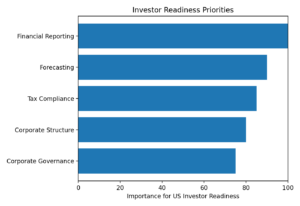
| Preparation Area | Why It Matters to US Investors |
| Corporate structure | Shows legal clarity and ownership transparency |
| Financial reporting | Builds investor confidence during due diligence |
| Tax compliance | Reduces regulatory and tax risks |
| Accounting standards | Makes financial statements easier to evaluate |
| Forecasting | Demonstrates financial planning and cash runway |
| Governance | Supports faster investment decisions |
Which Startups Benefit Most from US-Ready Accounting?
Startups and scaleups outside of the U.S., especially in countries like Israel or the UK, are often trying to raise venture capital or angel funds from U.S.-based investors; therefore, if examples were taken of an Israeli tech startup pitching to Valley investors or a London-based fintech meeting with NYC investors, both investors would have similar types of expectations to evaluate potential investments.
Additionally, all American investors will expect clear communications with adequate reporting of their financials and solid financial modelling (including both legal and tax) and to have confidence that any legal/tax modifications are handled appropriately (w/ documentation to support). Due diligence, as defined by the Small Business Administration in their statement is “management team, market, products/services, corporate governance and financial statement reviews” means that your finance function (i.e., cost of goods sold for example) must look good on Day 1.
CFOs of privately held companies in Israel should remember that the IFRS does apply for consolidated reporting purposes as well as the GAAP otherwise. For companies in the UK, they can use UK GAAP or IFRS (for UK publicly listed companies, they are required to use IFRS). Therefore, whether using UK GAAP or IFRS, U.S. Investors would expect to receive financials that are either GAAP or reconciled IFRS; therefore, a good CFO would have their financials prepared in accordance with IFRS or UK GAAP along with a clear explanation regarding the main differences that are present with U.S. accepted accounting principles.
When Do US Accounting and Securities Rules Apply?
You may not need to move to the U.S. for U.S. securities laws to apply to you. Exemption Strategy: When selling equity to U.S. persons (U.S. citizens or residents), you will need to do so under a SEC exemption, typically a Regulation D exemption. Structurally, many cross-border financings will be structured in a way where the offerings are conducted outside of the U.S. under Regulation S, or they will be private sales to accredited U.S. investors (Reg D). For example, if an offering was completed in Israel and there was no soliciting by U.S. persons, then the Regulation S safe harbor may be an option. In another example, if a startup sold shares to U.S. VCs via Reg D, it would need to file a short Form D with the SEC after the offering(s).
Foreign Private Issuer (FPI): It is helpful to think about FPI status. If 50% or less of your outstanding shares are owned by U.S. residents, then you would be classified as a Foreign Private Issuer and would be exempt from the reporting and information requirements under the full SEC reporting regime. (If you have more than 50% of your outstanding shares owned by U.S. residents, determined where your business operations and/or management are located, to determine whether you will be treated as a U.S. company.) As of now, most early-stage financings are done privately and exempt; however, it is important to consider the ownership structure.
Tax Residency: For the most part, raising capital is considered non-taxable; however, if U.S. Investors receive dividends, interest or royalties in the future, these payments will likely be subject to U.S. withholding tax (typically 30% unless reduced by treaty). Under the U.S.-Israel and U.K.-U.S. income tax treaties and their respective provisions on dividend taxation, the withholding rate can be as low as 10-15%. Additionally, PFIC/CFC rules may result in U.S. investors paying U.S. taxes on your retained earnings which would not impact you directly, but it would influence their perceptions of the attractiveness of your structure.
Building an Investor-Ready Accounting Structure
- Review Your Business Structure
Make sure your company structure, cap table, and governance documents are accurate and up to date. If you expect significant U.S. investment or operations, evaluate whether a U.S. entity may be beneficial in the future. - Strengthen Your Financial Reporting
Maintain accurate accrual-based accounting and prepare reliable profit and loss statements, balance sheets, cash flow reports, and financial forecasts. Use a consistent reporting framework such as IFRS or local GAAP. - Organize Compliance and Tax Records
Reconcile accounts, complete outstanding tax filings, and ensure all financial records are accurate. Investors expect clean books and well-documented financial information during due diligence. - Prepare Investor Documentation
Build a professional pitch deck, financial model, key performance indicators (KPIs), and cash runway projections. Clearly explain your company structure and revenue model to support investor discussions. - Maintain Strong Financial Governance
After fundraising, continue producing regular financial reports, maintain compliance with legal and tax obligations, and keep accurate corporate records. A well-managed accounting structure builds long-term investor confidence.
Final Thoughts for Founders Seeking US Investment
FAQ
Do we have to form a U.S. corporation to get U.S. investors?
Not necessarily. Many foreign startups raise funds under SEC exemptions without a U.S. entity. You can offer equity to U.S. investors (e.g. venture funds) via Regulation D (to accredited investors) or sell strictly offshore under Regulation S. That said, some founders later create a Delaware C-crop for future U.S. rounds or exits. But for early-stage fundraising, clean books and clear investor contracts are more important than adding a U.S. company.
Which accounting standard should we use?
You can continue using your local standard (IFRS or UK GAAP) for now. The SEC allows foreign companies to report in IFRS. U.S. investors will understand IFRS if needed – many global startups use it. However, be prepared to reconcile to U.S. GAAP for certain items. The key is consistency and full disclosure of your policies. If you plan a U.S. IPO later, you might eventually switch to US GAAP, but that’s a later stage concern.
What are PFIC and CFC, and why do they matter?
A PFIC (Passive Foreign Investment Company) is a foreign corporation where ≥75% of its income (or ≥50% of its assets) is passive (e.g. interest, dividends). A CFC (Controlled Foreign Corporation) is any foreign crop that is >50% owned by U.S. persons. If your company qualifies as either, any U.S. investor must file special IRS forms (like Form 8621) to report “phantom” income under U.S. tax rules. In practice, keep your business active and consider limiting U.S. ownership below 50% to avoid these regimes.
We use IFRS – will U.S. investors be okay?
Yes. U.S. regulators permit foreign firms to use IFRS. In fact, many international startups present financials in IFRS. Investors will either accept that or ask for a brief “GAAP reconciliation.” For example, key differences like R&D amortization or lease accounting may need explanation. The important thing is clear, audited statements. If your U.S. investors insist on GAAP, you can always produce adjusted reports later.