
A common question among startup founders is: “How can we get CFO‐level financial guidance without hiring a full-time CFO?” In Israel’s vibrant tech ecosystem (e.g. Tel Aviv and the “Startup Nation”), many early-stage companies face this dilemma. An outsourced or “fractional” CFO – such as the services offered by ERB Proximo – provides a solution. As ERB Proximo notes, growing startups can gain senior financial expertise on demand, without the long-term commitment or cost of an in-house hire. A CFO is the top finance executive, responsible for the company’s fiscal health – setting strategy, budgets, forecasts and funding plans. By working with an outsourced CFO, a startup can tap into those skills flexibly.
Key Takeaways
- Outsourced CFOs reduce financial overhead.
- Startups gain senior financial expertise without hiring full-time.
- Fractional CFOs improve fundraising readiness.
- Flexible engagement supports business growth.
- Ideal for Seed, Series A and scaling companies.
Understanding the Role of an Outsourced CFO
A Chief Financial Officer is the top level executive responsible for all things related to finance within an organization such as financial strategy, budgeting/forecasting, capital allocation, fundraising, and risk management. In the case of startups, they may not have any other employees besides their accountant and bookkeeper until they need a full-time CFO. However, outsourcing CFO duties through a contract or fractional CFO can provide this level of executive service without the associated costs.
The outsourced CFO can work with the founders on cash flow forecasting, producing reports for investors, developing price points, and developing growth plans while still being able to have a flexible working schedule without having to commit to a full-time position. This arrangement allows entrepreneurs to receive the benefits of a high-level finance professional with lower overhead costs by keeping their staff limited. In essence, using an outsourced CFO is equivalent to using a “CFO-as-a-Service.” They are experienced finance leaders who can provide support and guidance to help your venture navigate through the concept stage and into successful operations while allowing for flexibility in how often they are needed.
The Financial Advantage of Outsourced CFO Services
Cost efficiency and flexibility drive many start-ups to use contracted CFOs, rather than hire someone full-time as a CFO. It is difficult for most start-ups to pay a full-time employee $200,000+ annually as a CFO. (In the U.S.A) This is the average cost of hiring a CFO. The requirement of hiring an outsourced CFO only requires the start-up to pay for service it uses, which helps to minimize the complete cost of payroll taxes, benefits, and overhead. As an illustration, fractional CFO retainer rates are typically between $3,000-$10,000/month which represents less than half of what a full-time hire would cost.
Further, using outsourced CFOs provides the start-up with the ability to access high-level experts via an on-demand model. ERB Proximo brings together experienced finance professionals who help startups strengthen financial controls, improve financial reporting, and prepare for fundraising and international growth.
Finally, outsourced CFO providers can scale the number of resources required as needed as a start-up company expands or pivots.
As such, start-ups can quickly increase or decrease the amount of support received from their outsourced CFO providers. This opportunity to leverage the combination of senior-level expertise while scaling resources is often why many founders elect to use outsourced CFOs rather than pay a full-time CFO and add another fixed monthly salary to their overall expense base.
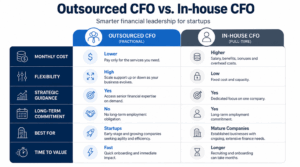
| Feature | Outsourced CFO | In-house CFO |
| Monthly Cost | Lower | Higher |
| Flexibility | High | Low |
| Strategic Guidance | Yes | Yes |
| Long-term Commitment | No | Yes |
| Best For | Startups | Mature Companies |
Why Founders Value Outsourced Financial Leadership
- Lower Costs: Outsourced CFOs eliminate the fixed overhead of a full-time hire. You pay for advisory services, not for benefits or a big salary.
- Access to Expertise: You tap into a senior financial leader with broad experience. Many fractional CFOs have served multiple industries and growth stages, so they bring best-practice insights faster.
- Scalability & Flexibility: You can increase or reduce CFO engagement as business needs change. This agility lets startups stay lean while still planning long-term.
- Strategic Focus: With financial management outsourced, founders can focus on core product and marketing. The outsourced CFO handles reports, forecasts and raising money, allowing the team to work “on” the business, not just “in” it.
- Investor Readiness: Outsourced CFOs help prepare clean financial statements and models. This improves credibility in funding rounds – investors expect solid forecasts and clear financial metrics, which a CFO can deliver.
Quick Highlights
✔ Lower operating costs
✔ Financial strategy
✔ Investor reporting
✔ Cash flow forecasting
✔ Fundraising support
Who benefits most?
Outsourcing CFO roles is an ideal solution for early- and mid-stage startup companies who have just received seed funding (or Series A/B) and are expanding their companies globally, and/or experience rapid growth. Many venture-backed companies don’t get a CFO until after they receive Series A/B, which means that until then, outsourcing provides the necessary support. Furthermore, if founders have multiple revenue streams or face regulatory issues, outsourced CFOs can help maintain proper financial discipline. In other words, any startup that requires top-level financial planning but doesn’t currently have (or can’t afford) a full-time CFO may benefit from working with a fractional CFO.
How to Choose the Right Outsourced CFO
Startups typically follow a few key steps to work with an outsourced CFO:
- Assess Your Needs and Timing: First identify why you need CFO help. Is it for fundraising prep, cash-flow planning, budgeting, regulatory compliance, or systemizing finances? (Many startups seek CFO support when preparing for a funding round or when cash runway becomes a concern.).
- Define Scope and Budget: Decide which tasks to outsource (e.g. financial modelling, KPI reporting, fundraise support) and how much time per month you can afford. Clarify goals so you can measure success (e.g. “prepare monthly board reports” or “build a 12‑month cash forecast”).
- Search for Providers: Look for reputable finance-service firms or fractional CFOs experienced with startups. Consider companies (like ERB Proximo in Israel) that offer bundled finance services or CFO retainers. Check credentials (experience, certifications) and ask for references.
- Interview & Select: Meet candidates or firms to ensure they understand your business. Good questions: Have they prepared startups for investor due diligence? Are they familiar with your sector? How will they communicate with your team and investors?
- Onboard & Integrate: Once hired, share your current financial data and plans. A quality outsourced CFO will quickly audit your books, set up reporting processes, and start advising. They should work as part of the team – attending key meetings, liaising with investors, and adjusting plans as needed.
- Review Regularly: Treat the outsourced CFO as you would any exec: schedule regular check-ins, review progress on goals, and refine the arrangement as your startup grows.
Each of these steps ensures you get maximum value. The goal is to make the CFO’s involvement as seamless as possible, so the startup gains confidence in its financial strategy while preserving agility.
The Bottom Line
An Outsourcing CFO can be a great help for a startup. The young company can “get seasoned financial leadership when it is needed” instead of hiring an executive with a long-term, fixed cost. ERB Proximo helps startups navigate local and international financial requirements, including tax planning, payroll, reporting, and investor readiness. Fractional CFO services are typically the right mix of expertise and economical for many Israeli and international startups.
FAQ – Common Questions from Founders
What exactly is an outsourced CFO? It’s a part-time or contract CFO who provides the same high-level financial leadership as a full-time CFO, but on a flexible basis. An outsourced CFO handles budgeting, forecasting, fundraising preparation, investor reporting and strategic planning – essentially all the “big picture” finance tasks – without being on your payroll.
Why not just hire someone in-house? Early startups often can’t afford a full-time CFO. Outsourcing gives you senior expertise at lower, variable cost. It also lets you scale the engagement up or down. In many cases, founders only need occasional CFO guidance until their business reaches a size ($10M+ revenue or a Series A/B funding stage) when hiring internally makes sense.
When should a startup bring in an outsourced CFO? Typically, when your financial or growth complexity outpaces the founders’ own skills. Common triggers are preparing for a funding round, expanding to new markets, or managing multiple product lines. If your finance spreadsheets aren’t keeping up with business questions, it’s time. Many VCs expect sound financial planning by Series A/B, so startups often engage fractional CFOs as they approach those rounds.
How much does an outsourced CFO cost? Costs vary by scope and region. In the U.S., a full-time CFO salary might start around $200K/year. By comparison, an outsourced CFO often works on a retainer or hourly basis. Typical monthly fees for early-stage startups can be in the range of $3,000–$10,000 per month, depending on experience and deliverables. This is generally much lower than a full-time hire.
How do I find a reliable outsourced CFO? Look for firms or individuals with verifiable startup experience. Ask for case studies (e.g. companies they’ve helped grow, funds they prepared). Check reviews or testimonials from other founders. In Israel, for example, ERB Proximo offers bundled finance services (CFO, accounting, payroll) and have ISO/quality certifications – indicating they follow best practices. Ultimately, the right outsourced CFO will understand your business model and communicate clearly with your team and investors.